
Am I Too Late to Study Art? Why It's Never Too Late to Start Drawing and Painting
One of the most common questions we hear at Cheshire Art Classes is:
"Am I too late to start drawing and painting?"
The short answer is simple: absolutely not.
In fact, many of our students begin their artistic journey later in life. Some are returning to art after decades away from it, while others are picking up a pencil or paintbrush for the very first time. Whether you're 18, 48, 68 or beyond, it's never too late to develop your creativity and learn new artistic skills.

The Biggest Myth About Art
Many people believe that artistic ability is something you're born with.
They'll say things like:
"I can't even draw a stick figure."
"I was never good at art at school."
"My art teacher said I was never any good."
"It's too late for me to learn now."
The truth is that art is a skill, not a magical gift.
Just as nobody expects to sit down at a piano and immediately play beautifully, nobody should expect to create a masterpiece on their first attempt. Drawing and painting are skills that improve through practice, our expert guidance, and patience.
Why Adults Often Make Great Art Students
Many people assume that children learn art more easily than adults. While children can be wonderfully creative with no fear, adults often bring advantages of their own.
As an adult learner, you may have:
More patience
Better focus
A stronger appreciation for the creative process
The motivation to learn for your own enjoyment
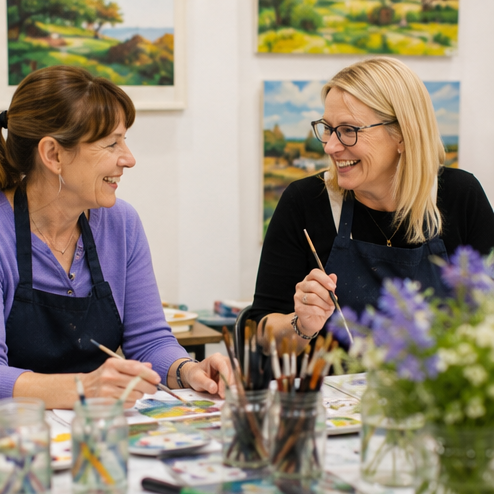
Adults often make excellent art students because they bring a lifetime of experiences with them. Visits to galleries, exposure to different cultures, travel, careers, hobbies, and personal interests all help shape their creative perspective. Art isn't just about technical skill—it's also about observation, experience, and how we interpret the world around us. Those are qualities that often grow stronger with age.
Many of our students find that learning art provides a welcome break from busy schedules, work pressures, and the constant distractions of modern life.
Art becomes a chance to slow down, observe, and enjoy being creative.
"But I've Never Drawn Before..."
That's perfectly fine.
Every artist starts somewhere.
You Don't Have to Draw Everything Freehand

One of the biggest misconceptions about art is that every artist simply sits down and magically creates a perfect drawing from scratch. In reality, artists have always used tools and techniques to help them understand shape, proportion, scale, and composition.
When we teach beginners at Cheshire Art Classes, we introduce a variety of methods that help students build confidence and develop their observational skills. Depending on the project, we might use graphite transfer paper, the grid method, measuring techniques, or observational drawing exercises.
Some beginners worry that using graphite paper to transfer a drawing onto a canvas is "cheating". It isn't.
The transfer is simply the foundation of the artwork. The real skill comes afterwards—understanding colour, tone, brushwork, texture, light, shadow, and learning how to bring a painting to life.
Professional artists throughout history have used all kinds of aids to help them achieve accurate results. What matters is not how the initial outline gets onto the canvas, but what you learn and create from that starting point.
As students gain confidence, they naturally begin relying less on these tools and develop stronger drawing skills of their own. The goal isn't perfection from day one; it's gradual progress, enjoyment, and building the confidence to tackle more challenging work over time.

The Benefits of Learning Art Later in Life
Many people begin art simply because they want to try something new. What they often discover is that the benefits go far beyond learning to draw or paint.
Art can help:
Reduce stress and anxiety
Improve concentration and mindfulness
Boost confidence
Encourage creative thinking
Provide a sense of achievement
Create opportunities to meet like-minded people
For many students, art becomes one of the most rewarding parts of their week.
You Don't Need Expensive Materials

Another common misconception is that learning art requires a studio full of expensive supplies.
In reality, our classes and courses provide all the premium materials you'll need to get started. This gives you the opportunity to experiment with different mediums, techniques, and equipment before deciding what you'd like to invest in for your own creative practice.
At Cheshire Art Classes, we guide students through the materials and techniques they need without overwhelming them. The focus is on learning, experimenting, and enjoying the creative process—not buying every art supply available.
Although, if we're being completely honest, discovering new art materials and treating yourself to a few exciting additions for your sketchbook or studio is all part of the fun!
The Best Time to Start Is Now
If you've been thinking about studying art for months—or even years—ask yourself this:
How much better could you be a year from now if you started today?
Every experienced artist was once a beginner.
Every confident painter once worried they weren't good enough.
The hardest part is often taking that first step.
Ready to Give it a Try?
Whether you've never picked up a pencil before or you're returning to art after many years away, we'd love to welcome you. Our classes are designed to be friendly, supportive, and suitable for all experience levels.
You don't need talent.You don't need experience.You don't need to be a certain age.
You just need the willingness to begin.


Comments